
"Soft-Handed" is a song about developers in the time of AI, which I released as The Human Exception. The music and the voice come from Suno v6, in a style I wrote, the lyric was written by Claude, and the cover was made with ChatGPT. Before sending the WAV to the distributor I heard two defects in it: a rustle at 0:37, and the word "six" in the first line, which sounded like "sip".
The released song is on YouTube and Spotify. Both defects are fixed in it. This post is about how.
I did the work in a Claude Code session. Claude ran the analysis and wrote the scripts. I listened to every result and decided what stayed. Every verdict below is mine, given by ear.
What I worked with
Suno gives you the take as a 16-bit, 48 kHz WAV and as an MP3. I checked that the two are aligned to the sample, so a timestamp in one is the same moment in the other.
For the analysis I used two tools from the pipeline I use for the songs' videos. Demucs splits a song into two stems, the voice and everything else (the band). Whisper transcribes the voice with a timestamp for each word. Both were only for measuring: nothing they produced went into the released audio.
The main tool for looking at sound is the spectrogram. Time runs left to right, frequency runs bottom to top, and colour shows how loud each frequency is at each moment. A sung vowel shows up as stacked horizontal lines (its harmonics), an "s" as a cloud of high frequencies, a click as a thin vertical line.
A rustle at 0:37
The rustle falls in the line "The new ones pull their chairs in, call me senior, and wait for me to know what I should know", in the short pause between "call me senior" and "and wait for me".
In the spectrogram it is easy to find: a burst of thin vertical stripes, like the teeth of a comb, from 0:36.55 to 0:37.35 and up to about 8 kHz.
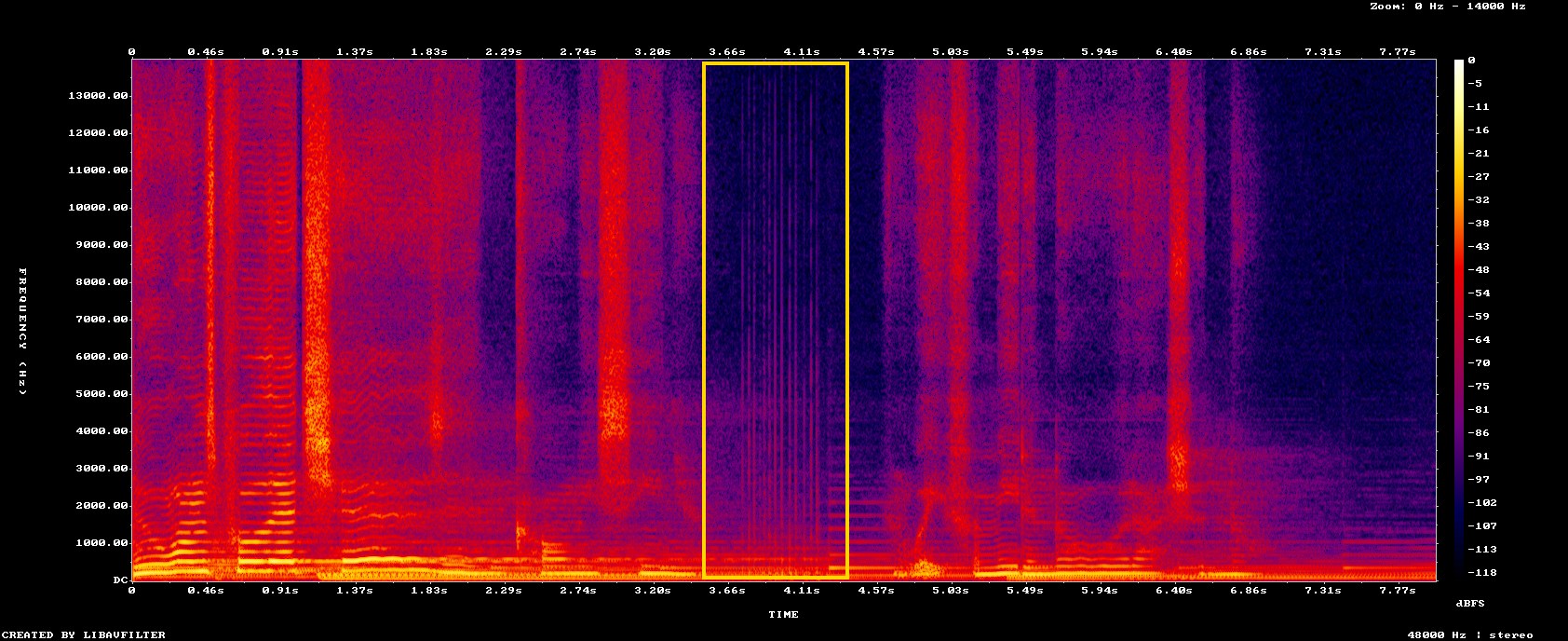
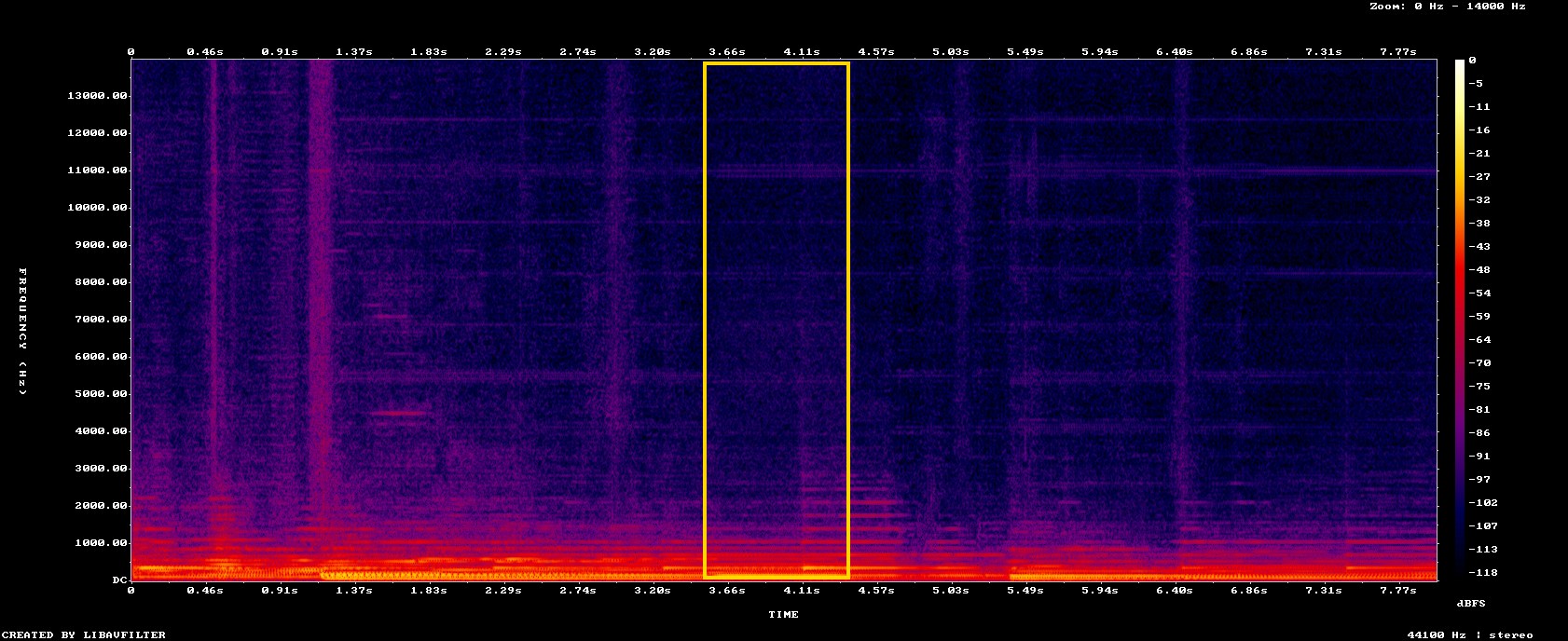
The yellow box marks the burst. The time axis of these images starts at 0:33, so the box covers 3.5–4.4 s. The spectrogram of the band stem shows the same burst, while the voice stem is silent there. So the noise belongs to the band, and it is an artifact of the generation.
First try: turning the noise down
The first idea was to remove the noise where it stands. A spectrogram is computed with a short-time Fourier transform (STFT): the audio is cut into short overlapping slices, and each slice is split into frequency bins. Each bin can be changed and the audio rebuilt from the slices.
So in the 0.8 seconds of the burst, and only there, every bin above 900 Hz was clamped: it could not be louder than the level of the same frequency just before and just after the burst (the lower of the two medians). Short 50 ms fades at both ends kept the change from clicking. Outside the window the file stayed identical, sample for sample.
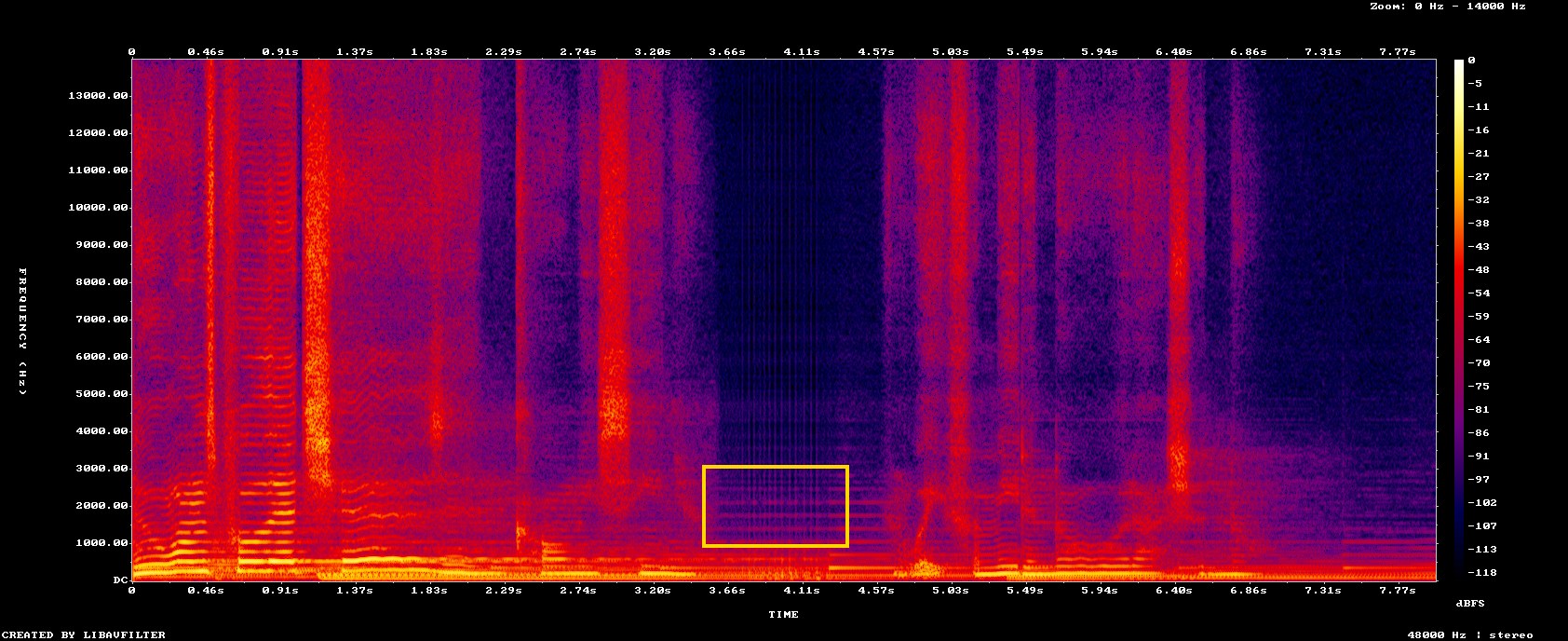
Above about 3 kHz the stripes are gone. Between 1 and 3 kHz, in the yellow box, they are still there, because in that range the band's own sustained notes are as loud as the burst, so the clamp has nothing quieter to clamp to. I could still hear the residue.
I also wondered whether there were other bursts like this one in the song. An automatic scan was not possible: the burst is about as loud as the percussion hits in the second verse, which come every two seconds or so, and a scan based on level cannot tell them apart. That part was left to listening.
Second try: asking Suno again
Suno has a Replace Section feature: you select a stretch of the song and it generates that stretch again. I selected 0:16.0 to 0:41.0, with both edges in pauses of the voice and the same four lines of lyric.
Suno sang the four lines in a different way and played a different arrangement under them: a new performance, and I wanted to keep the one I had. Twenty-five seconds with four sung lines left the model a lot to reinvent, and it did. I rejected it.
The fix: the band from another moment
The noise sits in a moment where only the band plays. Songs repeat themselves, so somewhere else the band probably plays the same chord at the same point of the beat, with no voice on top. If I could find that moment, I could lay it over the noisy one.
The search went like this. The video pipeline already had the beat grid of the song (about 117.6 BPM). The burst starts at a certain distance after a beat, so every other beat gives a candidate window at the same distance. Windows where the voice stem was louder than −45 dB were dropped. The rest were ranked on two scores:
- Chroma similarity. Chroma folds the energy of the low band (60–900 Hz) into the twelve notes of the scale, whatever the octave. Two windows with similar chroma are playing the same chord.
- Low-spectrum correlation. How closely the shape of the spectrum below 900 Hz matches, which catches the bass and the kick.
 1off = T0 - beats[beats <= T0].max()     # how far the burst starts after its beat
 2for b in beats:
 3    t0 = b + off                        # the same point after every other beat
 4    t1 = t0 + (T1 - T0)
 5    if vocal_db(t0 - 0.15, t1 + 0.15) > -45:
 6        continue                        # a voice is singing here
 7    c = chroma(t0 - 0.4, t1 + 0.3) @ ref_chroma
 8    l = np.corrcoef(lowspec(t0, t1), ref_low)[0, 1]
 9    cands.append((c + l, t0))
The best match was 0:19.85–0:20.77, the pause between "ten to six" and "the pager's" in the first line, with a chroma similarity of 0.93. A candidate in the outro, at 4:33, had stripes of its own.
The patch replaced 0:36.49–0:37.41 with that segment. Its level was matched to the audio around the window, and it was blended in with equal-power crossfades reaching 60 ms either side of each edge. An equal-power crossfade keeps the sum of the two signals' energy constant, so the patch does not dip or swell at the seams:
 1w = np.ones(L)
 2r = np.linspace(0, np.pi / 2, 2 * k)
 3w[:2 * k] = np.sin(r)                   # the patch fades in
 4w[-2 * k:] = np.cos(r)                  # and out
 5b[seg] = a[seg] * np.sqrt(1 - w[:, None] ** 2) + patch * w[:, None]
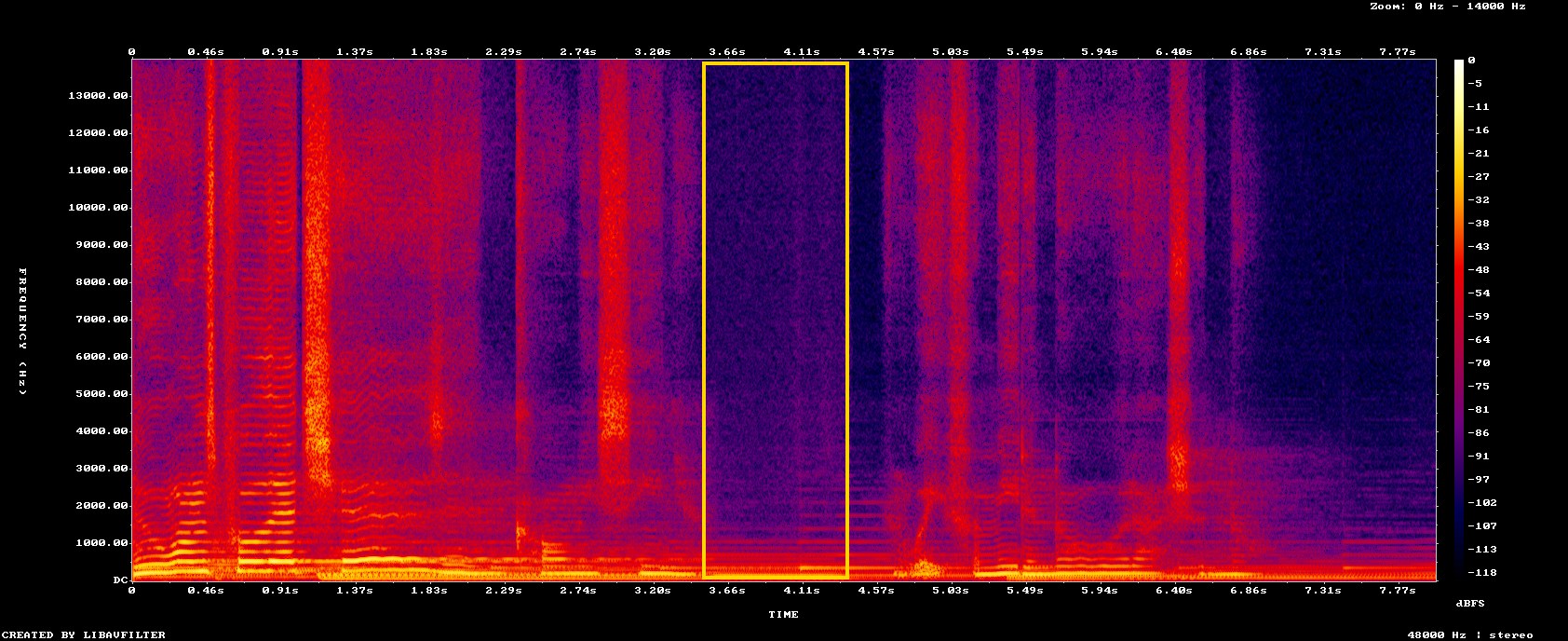
The yellow box is the same window as in the first image, and the stripes are gone. I listened and heard nothing at 0:37. The patch changed 44,140 samples.
A "six" that sounded like "sip"
The first line of the song is "Friday, ten to six, the pager's shaking on the desk", and I heard its "six" as "sip".
An "s" lives mostly above 3.5 kHz, so I measured the word in the 3.5–9 kHz band. The initial s is strong. After the short vowel there is a click at about 0:18.66, where the voice releases the word, and then almost nothing: the final s is about 28 dB weaker than the initial one, which in practice means it is not there. The word ends on a stop, and that stop sounds like a p. Whisper still wrote "6", helped by the context.
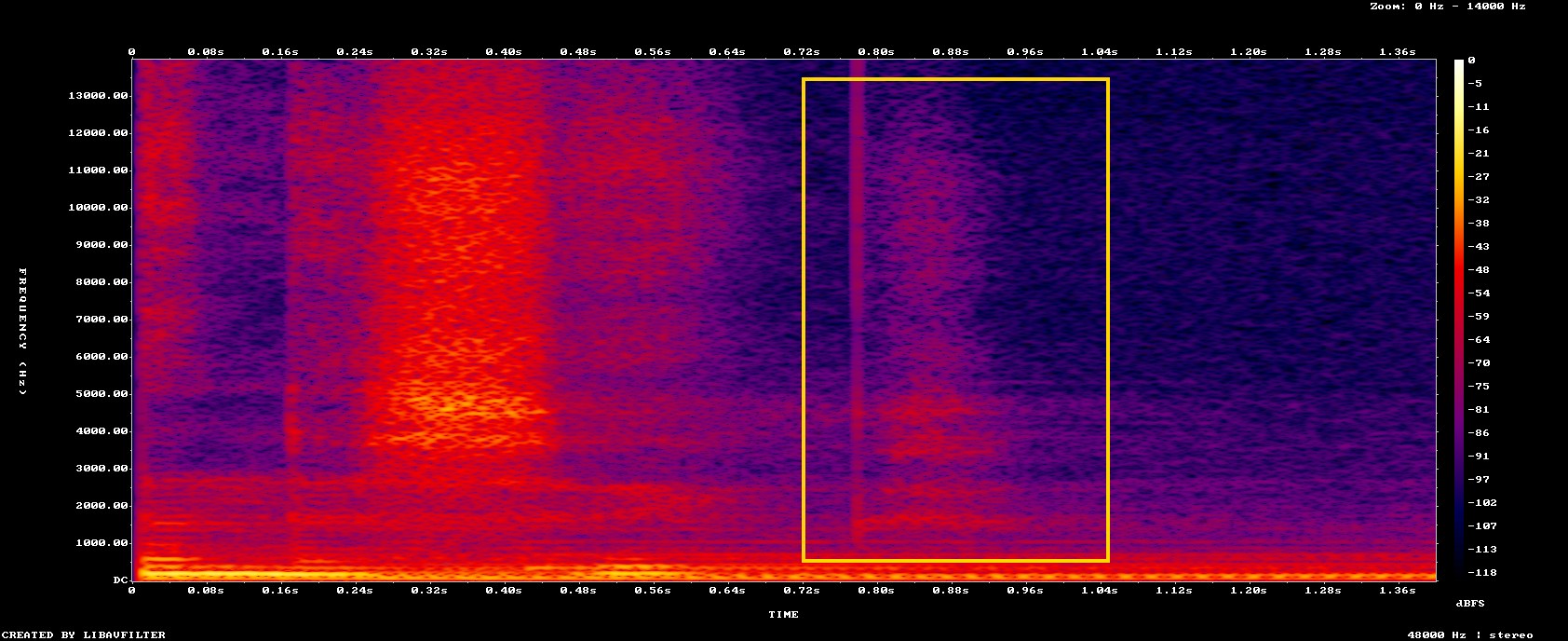
In this image the time axis starts at 0:17.9: the initial s is the bright cloud at 0.25–0.45 s. The yellow box covers 0:18.62–0:18.95, the window the final repair changed: the click is the thin vertical line at about 0.77 s, and where the final s should be there is almost nothing.
I did not try Replace Section on the word: the first attempt had already shown that it changes the performance. So every fix below is a graft. A short piece of the same voice is added over the mix, high-passed first, so that only the top of the voice comes along and no band from the other moment comes with it. The high-pass is a smooth mask on the spectrum: zero below one frequency, full above another, a ramp in between.
 1def hp(x, lo, hi):
 2    f = np.fft.rfftfreq(len(x), 1 / sr)
 3    m = np.clip((f - lo) / (hi - lo), 0, 1)
 4    return np.fft.irfft(np.fft.rfft(x, axis=0) * m[:, None], len(x), axis=0)
The word's own s
The simplest graft was to copy the initial s of the same word (0:18.15–0:18.31), high-pass it at about 3.5 kHz, and add it after the click, at −6 dB and at −10 dB.
It read as "sips". The p-like release was still there, and the s landed after it. The release itself had to go.
The "ks" of other words
The second graft did both. It turned the release down above about 1.5 kHz and laid in its place the "ks" of "checks", from "Green checks all the way down" at 0:42.355–0:42.545, with its s at −4 dB and at −8 dB against the initial s of "six". The first version landed late, after the click, and was redone with the click placed at 0:18.66. That one was much better, though still not quite right.
For the third, the release was removed completely above about 0.9 kHz, and the "ks" came from "works", in "It works, ship it" at 2:04.40–2:04.60. The band stops for that line, so it is the cleanest "ks" in the song. This was the best graft so far. I also tried the same setup with a shorter "ks" from "checks".
The same word, sung again
At this point I remembered that I had another take of the whole song: the output of the Replace Section from the first defect, with the first line sung again. Its "six" has the same habit, with the final s 30.5 dB below the initial one. So the "sip" comes from the way this voice sings the word, in both takes I had.
The whole word could not be moved across, because the band under it is a different arrangement. Its ending could, though. The final graft:
- removes the original release above about 0.9 kHz, from 0:18.635 to 0:18.84;
- takes the ending of "six" from the other take (its 0:18.17–0:18.50) and high-passes it at about 1.8 kHz, so its band stays behind;
- lays it at 0:18.62, at its natural level: the ratio between the final and the initial s measured in the other take, applied to the initial s of this one.
 1seg = b[i0:i1]
 2b[i0:i1] = seg - hp(seg, 900, 1500) * w[:, None]    # the release, gone above ~0.9 kHz
 3x = hp(other[int(18.17 * sr):int(18.50 * sr)], 1400, 2200)
 4x *= env[:, None] * gain                            # fades, natural level
 5at = int(18.62 * sr)
 6b[at:at + len(x)] += x
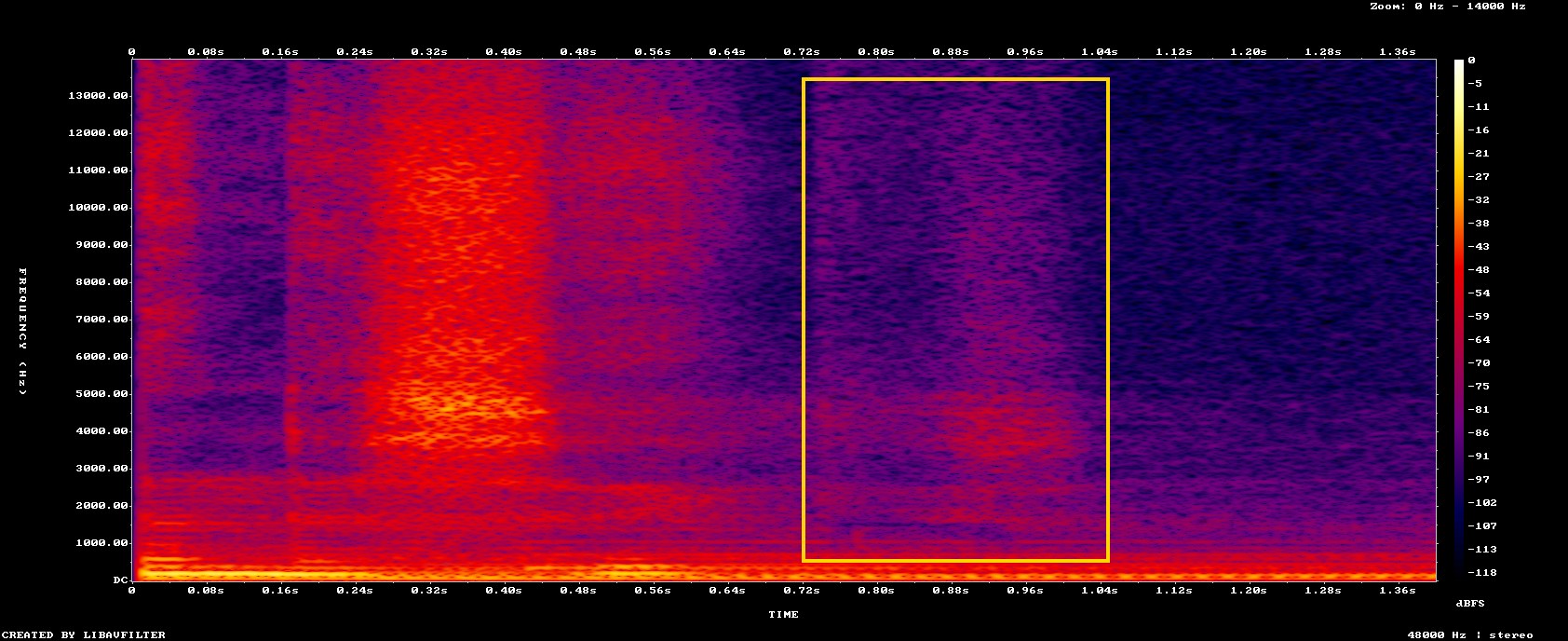
In the same yellow box, the click is gone and a soft s follows the vowel. I also tried it 6 dB louder, and chose the natural level. The word reads "six" now. This repair changed 15,710 samples, between 0:18.62 and 0:18.95.
Checking what changed
After every step, a short script compared the repaired WAV with Suno's sample by sample and printed how many samples differed and where. In the released file 59,850 samples differ from Suno's, all between 0:18.62 and 0:37.41. The rest of the song is identical to the bit. That file is the WAV I sent to the distributor.
What I learned
- The ear finds, the spectrogram explains. I heard both defects. The spectrogram placed them to the hundredth of a second and showed what they were: an artifact in the band, and a final consonant that was missing.
- Turning a sound down works only where it stands out. The clamp cleaned the high band, where the burst was alone, and could do nothing where the band's harmonics were as loud as the burst.
- The best patch comes from the song. A pause where only the band plays, on the same chord at the same point of the beat, covered the noise without a seam. The end of the same word, sung by the same voice in another take, fixed "six".
- Regenerating gives you a new performance. Replace Section gave me a different take of the whole section, with a different voice and arrangement.
- For a consonant, the context counts more than the sound. An s added after a p-like release still reads "sips". The release had to go first.
- Keep every change local, and check it. The comparison after each step is what let me trust that the rest of the song was untouched.
Get the next posts by email
An occasional newsletter with my new Posts, with one-click unsubscribe. How I handle your address.